
Empty Buildings, Open Questions: Green Bay's Proposed Vacant Commercial Property Registry
October 13, 2026 · Dane G. Lasecki
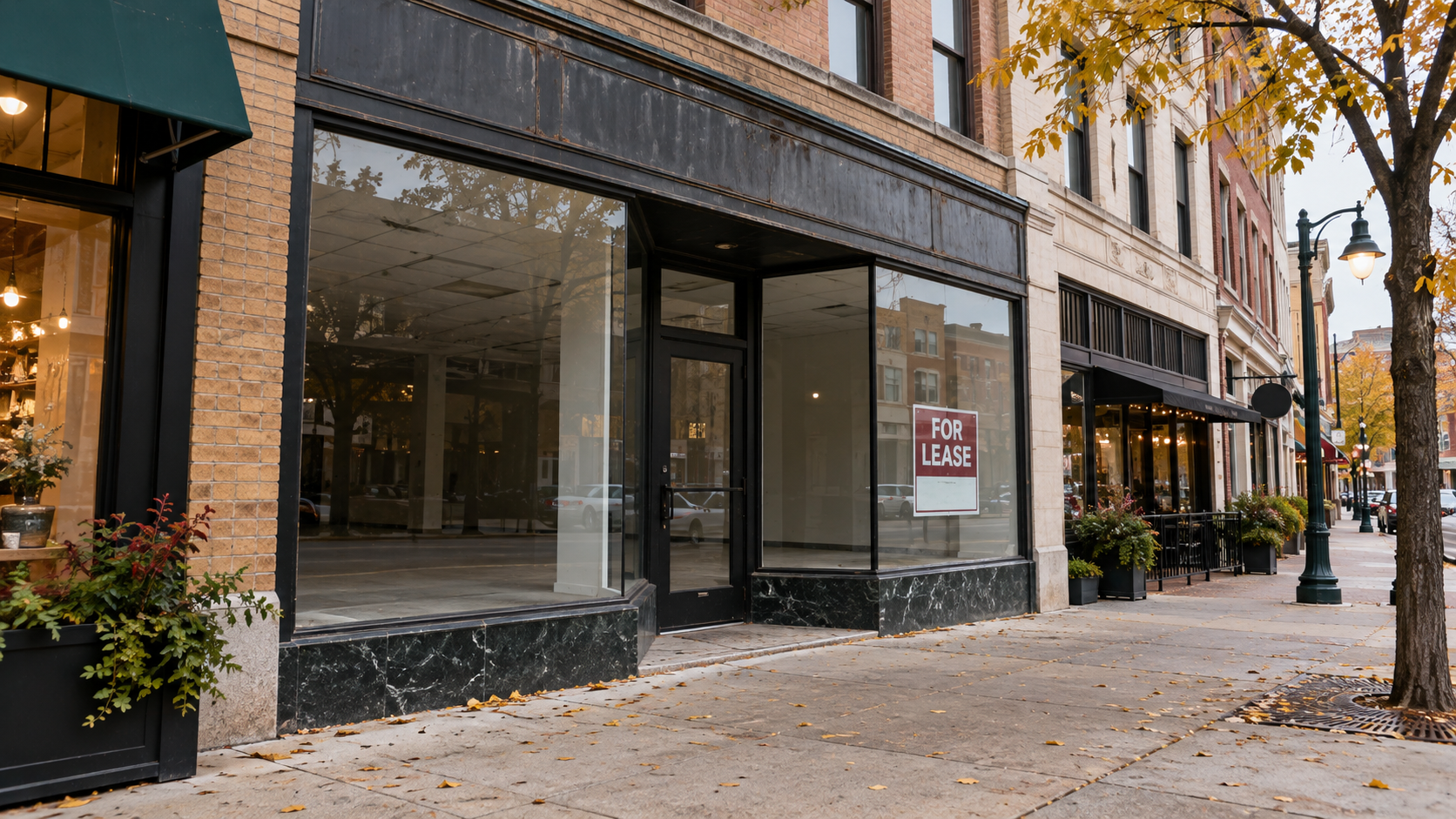
Green Bay’s Common Council is weighing General Ordinance 24-26, which would require owners of fully vacant commercial buildings to register with the City and pay annual fees that rise to $4,000. This Grow Green Bay white paper reviews the ordinance, the research on vacant property registries, and how other Wisconsin cities handle the issue. We find that the problem is real but unmeasured. Registration has solid evidence behind it, but escalating vacancy fees have little. The fee also falls hardest on owners of smaller buildings, may be legally vulnerable, and includes provisions that could slow redevelopment. The paper closes with policy options. The main one is to start the registry, hold the fees until the City knows how many buildings it has, and target neglect rather than vacancy.
Empty Buildings, Open Questions: Green Bay's Proposed Vacant Commercial Property Registry
Oct 13, 2026
A Grow Green Bay policy white paper · By Dane G. Lasecki, Executive Director
Abstract
In October 2026, the Green Bay Common Council will consider General Ordinance 24-26, which would require owners of fully vacant commercial buildings to register with the City and pay annual fees escalating from $500 to $4,000. This paper evaluates the proposal against its stated goals. It draws on the ordinance text, local reporting, the programs of five other Wisconsin cities, the national research on vacant property registration ordinances, illustrative calculations at 2025 property tax rates, and Wisconsin's statutory limits on municipal fees. We find that registration and maintenance requirements have empirical support, but there is little evidence that escalating vacancy fees by themselves return commercial buildings to use. As drafted, the fee falls hardest on owners of lower-value buildings, may be open to challenge under Wis. Stat. § 66.0628, and could raise the cost of acquiring and redeveloping long-vacant buildings. We also find no public record that the city weighed alternative designs, and we outline options that would preserve the registry's benefits while reducing these risks.
Executive summary
Green Bay's proposed vacant commercial property registry pairs a well-supported idea, knowing which buildings are empty and who is responsible for them, with a fee structure that charges owners for vacancy itself rather than for neglect. The Common Council is scheduled to consider General Ordinance 24-26 on October 20, 2026.
Key findings
The problem is real but unmeasured. Long-vacant buildings impose costs on their neighbors, yet the City has no inventory of how many exist.
Registration has empirical support; vacancy fees have little. The strongest study of these ordinances found they more than halved the harm foreclosed homes did to neighboring property values, an effect the authors tie to the condition of neglected properties; the study did not isolate the role of fees. We found no rigorous evidence that escalating fees alone fill vacant commercial buildings.
The fee is regressive by building value. At 2025 tax rates, the $4,000 fee equals about 70 percent of the annual property tax on a building assessed at $250,000, but 3.5 percent on one assessed at $5 million.
The fee may be legally vulnerable. Wisconsin law requires municipal fees to bear a reasonable relationship to the service provided. A fee designed to escalate in order to change behavior, rather than to recover costs, may be challenged as a disguised tax.
Some provisions could slow redevelopment. Unpaid fees follow a building to its next owner, pre-development time is not exempt, and good-faith marketing is protected for only 12 months.
Green Bay would sit at the steep end of Wisconsin practice. Of the roughly five Wisconsin cities with comparable programs, only South Milwaukee uses a comparable escalating schedule; Milwaukee charges only for inspections, and Menasha directs its fees to façade grants. The public record does not show whether officials considered such alternatives.
The paper describes the ordinance, reviews why commercial buildings sit vacant and what the research shows, compares Wisconsin practice, estimates the cost to owners, considers the legal question, and identifies design options.
1. Introduction and method
This paper asks whether General Ordinance 24-26 is well designed to achieve its own stated purposes: to secure and maintain vacant commercial buildings, improve emergency response and code enforcement, and encourage timely rehabilitation, occupancy, or redevelopment.[1] It is an analysis of the text before the Council, not an endorsement of any candidate or a recommendation on any individual vote.
Scope. The analysis covers Draft 2 of the ordinance as forwarded by the Protection and Policy Committee in October 2026. It addresses commercial property only, as the draft does.
Sources and method. We draw on five kinds of evidence:
The ordinance text and the public record of its development, including local news coverage.[1][2][3][4]
Published research on why commercial space sits vacant and on the effects of vacant property registration ordinances.[5][6][7][8][9]
The vacant building programs of Milwaukee, South Milwaukee, Kenosha, Menasha and Oshkosh.[2][10][11][12]
Illustrative calculations of the fee's burden at the City's 2025 combined property tax rate.[13]
Wisconsin's statutory standard for municipal fees.[14][15]
We conducted no interviews or surveys and had no access to parcel-level vacancy data, which the City reports it does not maintain. Section 13 describes the limits these choices place on our conclusions.
2. Background
Vacant commercial buildings impose costs beyond their owners. The Wisconsin Economic Development Corporation estimates that a single vacant storefront costs a community about $133,200 in lost economic activity.[2] Vacant buildings are also associated with break-ins, vandalism, and fire risk, and with lower values for nearby property.[8][9]
Green Bay has prominent long-term examples. The historic building at 402 Dousman Street downtown has been dormant for at least 15 years.[3] City officials acknowledge, however, that they have no comprehensive list of vacant properties and know mainly of "problem properties" that generate police or inspection calls.[2]
Legislative history
The sponsor, Alder Joey Prestley, has described residents "seeing the cost of having a vacant property spilling over into the rest of the neighborhood" and called the registry "arguably as important as the fee structure."[2] Alder Jennifer Grant, who opposed the June referral, argued that existing ordinances could be amended instead.[2]
3. What General Ordinance 24-26 would do
The ordinance would require owners of fully vacant commercial buildings to register within 60 days and renew every January 31, paying an annual fee that doubles until it reaches $4,000.[1] A building still vacant at its sixth renewal would have paid $15,500 in total.

Source: General Ordinance No. 24-26, Draft 2, fee schedule. Years 5 and 6 repeat the $4,000 fourth-renewal fee.
How long before the first fee? The free initial registration is valid only through December 31 of the year it is filed, and the first $500 fee is due at the next January 31 renewal. Depending on when a building becomes vacant, the first fee can come due anywhere from about three to fourteen months after registration, unless an exemption applies.
4. Why commercial buildings sit vacant
A policy aimed at vacancy should match its causes, and commercial vacancy has several. A 2018 review for the San Francisco Board of Supervisors identified ten contributing factors, and a Strong Towns analysis the same year reached similar conclusions.[5][6] They fall into four groups:
The implication is that a vacancy fee can reach only part of the problem. Where buildings sit empty because they are expensive to bring up to code or poorly matched to current zoning, the more direct remedies are regulatory: flexible change-of-use rules, smaller permitted commercial units, and help with build-out costs. San Francisco's analysts and Seattle's zoning reforms both point in that direction.[5]
Vacancy still costs the block
Not all of vacancy's cost comes from neglect. A secured, well-maintained building that sits empty still produces no foot traffic, no customers for neighboring businesses, and no street life; the $133,200 estimate in Section 2 measures the cost of emptiness, not disrepair.[2] Supporters are right that this cost is real. The question is which tool reduces it fastest. For buildings held empty by choice, a carrying cost may help. For buildings held empty by code, market or build-out barriers, the faster path to occupancy is lowering those barriers through grants, temporary uses and simpler change-of-use rules.
5. What the research says
The research supports registration and maintenance requirements, but offers little direct evidence on escalating fees for vacant commercial property. Most studies come from the residential foreclosure crisis.
Vacant property registration ordinances spread quickly and vary widely. A national database compiled by Lee, Terranova, and Immergluck coded 550 local ordinances on more than 30 characteristics. Adoption surged in 2008 and 2009, at the peak of the foreclosure crisis, and continued more slowly afterward.[7]
The best causal evidence finds that registries reduce harm to neighbors through maintenance. Economists at the Federal Reserve Bank of Atlanta compared Florida properties on either side of borders between jurisdictions with and without ordinances. They found the ordinances "more than halved the negative externality from foreclosure" on nearby home values. They attribute the effect to the condition of neglected or unsecured properties, not to vacancy as such.[8] The study did not separate the effect of fees from that of maintenance requirements, and many of the ordinances it examined charged fees. Its findings most directly support the security and maintenance provisions of Green Bay's draft.
Practitioners stress calibration. The Greater Ohio Policy Center, which favors registries, notes that typical fees range from $0 to just over $600 a year and that a modest fee is unlikely to change an owner's calculations. It warns that in weak markets, fees can push otherwise compliant owners toward abandonment, and it describes waivers for owners with rehabilitation plans and rebates when a property returns to use.[9] The Center also argues that fees reflect the real cost of holding vacant property and need not deter responsible investment. Green Bay's $4,000 top tier is well above the range it describes.
Commercial registries are hard to enforce and hard to evaluate. San Francisco's Budget and Legislative Analyst reviewed the city's commercial vacancy registries in 2018. In 2016, they listed 28 commercial buildings and 25 storefronts, against 3,448 vacant business addresses counted by the U.S. Postal Service. Only 20 to 25 percent of registrants paid their fees, enforcement relied on complaints, and the analysts concluded that the programs' contribution to falling storefront vacancy "cannot be determined."[5]
What this means for Green Bay. The evidence favors the parts of the ordinance that identify owners and enforce maintenance. It neither confirms nor rules out that escalating fees will fill commercial buildings, and it suggests that results depend heavily on the City's capacity to find vacant buildings and enforce consistently.
6. How other Wisconsin cities handle vacant buildings
Wisconsin cities that register vacant buildings mostly charge modest flat fees or inspection costs; Green Bay's draft would sit at the steep end, alongside South Milwaukee. About five cities statewide run comparable programs.
Two models stand out. Milwaukee shows that a registry can operate with no vacancy surcharge, charging only when the City must inspect. Menasha shows that fee revenue can be directed at the problem itself, through grants that help buildings re-lease. We found no published evaluations of the South Milwaukee or Kenosha programs.
7. The cost to owners: an illustration
The same fee weighs very differently on different buildings. At Green Bay's 2025 combined property tax rate of $22.71 per $1,000 of assessed value (City $8.37, Green Bay Area Public Schools $10.11, Brown County $3.51, NWTC $0.72), the top $4,000 fee ranges from about 70 percent of a small building's annual tax bill to under 4 percent of a large one's.[13]
These figures are illustrative, not parcel-level estimates; actual bills depend on each property's assessment and any credits. Put another way, the top fee is about $333 a month: modest next to most commercial rents, but owed whether or not the building has any code problem. Two implications follow. First, for owners of large buildings, the fee is likely too small relative to holding costs to change behavior, consistent with the practitioner literature.[9] Second, for owners of a single modest storefront, the fee is a substantial added cost that does nothing to address the physical or market barriers in Section 4. In effect, the fee is regressive because it builds value.
8. Legal considerations: fee or tax?
The escalating schedule raises a question the Council should resolve before adoption: whether the charge is a fee or, in substance, a tax. Wisconsin law provides that any fee imposed by a political subdivision "shall bear a reasonable relationship to the service for which the fee is imposed."[14][15]
General Ordinance 24-26 does not tie its fee schedule to the City's cost of administering the registry or inspecting buildings. Its escalation, from $500 to $4,000, follows the length of vacancy rather than any increase in the City's costs, and the ordinance's stated purpose includes encouraging occupancy. A charge designed mainly to change behavior or raise revenue, rather than to recover the cost of a service, is the kind of charge most exposed to challenge under this standard.
The question is not hypothetical in Wisconsin. In 2021, the Wisconsin Institute for Law & Liberty challenged Lake Geneva's $750 annual short-term rental license fee before the Wisconsin Tax Appeals Commission on these grounds, arguing it bore no relation to the City's licensing costs. Lake Geneva had already cut the fee from $2,000 after an earlier warning letter. The challenge was settled in early 2022: the City lowered the fee to $400 and refunded the difference to the owners who brought it.[15][16]
We do not offer a legal opinion, and we have not reviewed any analysis by the City Attorney. Options that would reduce the risk include a cost-of-service study supporting the fee levels, a schedule based on inspection costs as in Milwaukee, or a penalty structure tied to specific code violations rather than to vacancy.
9. The public debate
Supporters and critics largely agree that long-vacant buildings are a problem; they disagree about whether charging owners for vacancy will solve it.
Arguments made by supporters
Vacancy has public costs. Vacant buildings generate police, fire, and inspection activity and depress nearby investment, so owners who leave buildings empty should help bear those costs.[2][4]
Fees create urgency. Escalating charges encourage owners to lower asking rents, sell or reinvest rather than hold buildings empty indefinitely.
Responders need a contact. A registry gives emergency responders a local agent for every vacant building.
The City needs data. A registry would produce the first inventory of vacant commercial space and could help match buildings with developers.[2]
Good-faith owners are protected. Owners who are building, marketing, recovering from a casualty or in legal proceedings pay nothing.[1]
Arguments made by critics
Real estate groups and several alders have raised these objections:[2][4]
The scope is unknown. The City cannot say how many buildings would be affected.
Existing tools already apply. Building, fire, and nuisance codes can already reach unsafe or neglected buildings.
It penalizes lawful ownership. An owner who keeps a vacant building secure and up to code still pays escalating fees.
It ignores market conditions. The draft makes no provision for recessions, and the 12-month marketing exemption may be too short for some buildings.
It could deter investment. Brokers report that Green Bay already competes at a disadvantage on taxes and permitting, and critics argue a vacancy fee would add to that perception.
It could expand. The June referral included residential property, which critics fear could return.
The evidence in Sections 5 through 8 bears on several of these claims. Others, including Green Bay's competitive position on taxes and permitting, are assertions that would benefit from data before they settle the question either way.
10. Key design questions
Whether the ordinance helps or hurts depends less on the idea of a registry than on eight design choices in the text.[1]
Vacancy or neglect? Fees attach to emptiness, not condition. A secured, maintained building pays the same as a deteriorating one, although the strongest evidence links registries' benefits to maintenance and security (Section 5).
Who inherits the fees? Unpaid fees run with the property, and a sale "does not restart the registration process." A buyer who acquires a long-vacant building to redevelop it may inherit both its arrears and the $4,000 tier. Buyers can price known arrears into a purchase, but uncertainty about the fee tier is harder to price. The text should state whether the tier resets.
What about the period before a permit? Construction is exempt only under a valid building permit. Design, financing, zoning approvals, and, for historic buildings, tax-credit applications can precede a permit by many months.
Is 12 months of marketing enough? Owners who list in good faith begin paying after a year, with no allowance for downturns or for buildings that are harder to place.
Are penalties proportionate? Per-day penalty language is common in municipal codes, and courts rarely impose maximums. Still, a missed $500 renewal could in principle draw $250 to $5,000 per day, with no notice-and-cure step before forfeitures accrue.
Who bears the cost? As Section 7 shows, the fee is a far larger share of the tax bill for small buildings than for large ones.
Does it reach the vacancy residents see? Only fully vacant buildings are covered, so an empty ground-floor storefront beneath occupied offices or apartments is not. Because demolition removes a building from the registry, the fee could make teardown more attractive for owners of older buildings, though we found no evidence that this happens in practice.
How will we know if it works? The draft has no inventory baseline, no reporting requirement, no sunset, and no rule directing fee revenue to inspection or redevelopment. San Francisco's experience shows how hard evaluation becomes without these.[5]
Were alternatives weighed?
Draft 2 adopts a single fee model, an escalating schedule modeled on South Milwaukee's. The public record we reviewed does not show which alternatives staff or the Protection and Policy Committee considered, or why they were set aside.[2][4] That is a fair question to resolve before a full Council vote, because cities have tried many designs:
Grow Green Bay does not endorse any one of these. The point is that a policy with this many workable designs deserves a record showing they were compared. Questions the Council could reasonably ask staff include:
How many buildings would be covered, and how was that estimated?
What will the program cost to administer, and how were the fee levels set?
Which alternative designs were considered, and why was this one chosen?
How will the City measure whether the program works?
Technical drafting issues
Section numbers are placeholders ("Sec. #-#"), and "Responsible Department" and "Code Official" are not defined.
Registration requirements appear twice in slightly different language.
The effective-date clause ("after its passage and publication on January 1, 2027") is ambiguous.
Government property is exempt, but nonprofit-owned buildings such as closed churches and schools are not.
Treatment of mixed-use buildings turns on the undefined word "primarily."
Appeals go to the Zoning Board of Appeals, a body designed for zoning variances rather than fee disputes.
11. Interests at stake
The ordinance's costs fall on a defined group of owners, while its benefits are spread across neighbors, responders, and the City. The table describes how each group's interests are affected; it does not characterize any group's position.
12. Policy options
Green Bay can keep the registry's benefits while narrowing its risks. The options below follow from the evidence above and from practice in other Wisconsin cities.
Start the registry, then set fees. Adopt registration now and let its first year build the inventory before any fee schedule takes effect. U.S. Postal Service vacancy data, which HUD publishes by census tract and which distinguishes business addresses, offers a low-cost check on the registry's completeness, as San Francisco's analysts recommended.[5]
Keep registration free and mandatory. As in Milwaukee, every vacant building would have a local agent and emergency contact without a vacancy surcharge.[10]
Tie charges to condition and cost. Begin escalating charges only after a documented code, fire, or nuisance violation goes uncorrected, or charge inspection fees supported by a cost-of-service study (Section 8).
Give buyers a clean slate. Reset the fee tier on an arm's-length sale, and exempt a defined pre-development period before a permit issues.
Recognize good-faith marketing. Extend the sale-or-lease exemption beyond 12 months where an owner shows continuous listing at market terms.
Add notice and cure. Require written notice and 30 days to correct before daily forfeitures begin for paperwork violations, and cap the total.
Count temporary activation. Treat pop-up retail, galleries, and short-term leases as occupancy or as clock-pausing, building on Downtown Green Bay, Inc.'s existing pop-up shop program.[17]
Pair fees with incentives. Follow Menasha in directing revenue to façade grants, and address the physical and regulatory barriers in Section 4 through faster change-of-use permitting and a review of code obstacles to adaptive reuse.[11]
Guard against demolition. Ensure the registry does not make teardown the cheapest exit for owners of older buildings.
Build in evaluation. Add a two-year sunset or required report on registrations, fees collected, buildings returned to use, and enforcement costs.
13. Limitations
No local vacancy count. Neither the City nor this paper has a parcel-level inventory, so we cannot estimate how many buildings the ordinance would reach or how much revenue it would raise.
Residential-dominated evidence. The strongest causal research concerns foreclosed homes; its findings may not carry over fully to commercial property.
Illustrative cost estimates. Section 7 uses round assessed values and the 2025 combined rate, not actual parcels or credits.
Incomplete comparison data. We could not verify the details of Oshkosh's program, and no evaluations of the South Milwaukee or Kenosha programs were available.
No legal opinion. Section 8 identifies a legal question; it does not resolve it.
A moving target. The ordinance may be amended before or at the October 20 meeting.
14. Conclusion
General Ordinance 24-26 addresses a real problem, and the research supports its core idea: the City should know which commercial buildings are empty and who is responsible for them. The escalating vacancy fee is on weaker ground. It reaches compliant owners as well as negligent ones, weighs most heavily on owners of modest buildings, may be open to legal challenge, and in its current form could raise the cost of rescuing the buildings the City most wants back in use.
In Grow Green Bay's assessment, the strongest version of this policy would start the registry now, set any fees only after it shows the scope of the problem, keep registration free, enforce against neglect rather than vacancy, and reward the owners and investors who return buildings to productive use.
Notes
City of Green Bay, General Ordinance No. 24-26, "Vacant Commercial Property Registry," Draft 2 (2026).
Wisconsin Public Radio, "Green Bay considers vacant building registry with fees", June 19, 2026.
FOX 11 News, "Green Bay moves forward with property registration & fee program for long-vacant buildings", June 16, 2026.
WBAY, "Green Bay council approves vacant property ordinance study", June 17, 2026.
San Francisco Budget and Legislative Analyst's Office, Commercial Vacancies in San Francisco, report to Supervisor Yee, January 16, 2018.
Tracy Hadden Loh and Michael Rodriguez, "Why Is That House or Storefront Vacant?", Strong Towns, August 30, 2018 (originally published by Greater Greater Washington).
Yun Sang Lee, Patrick Terranova and Dan Immergluck, "New Data on Local Vacant Property Registration Ordinances", Cityscape 15, no. 2 (2013): 259–266.
Arnab Biswas, Chris Cunningham, Kristopher Gerardi and Daniel Sexton, "Foreclosure Externalities and Vacant Property Registration Ordinances", Federal Reserve Bank of Atlanta Working Paper 2019-20 (2019); published in Journal of Urban Economics 123 (2021).
Greater Ohio Policy Center, "Misconceptions About Vacant Property Registries", September 2018.
City of Milwaukee, Department of Neighborhood Services, "Vacant Building Registration", accessed October 13, 2026.
City of Menasha, "Vacant Building Registration", accessed October 13, 2026.
City of Oshkosh, Inspection Services, "Vacant Building Registration Program", accessed October 13, 2026.
City of Green Bay, 2025 Combined Property Tax Report. Combined rate is the sum of the four listed jurisdictions.
Wis. Stat. § 66.0628, "Fees imposed by a political subdivision," in Wisconsin Statutes, ch. 66, subch. VII.
WisPolitics, "WILL challenges Lake Geneva's short-term rental fee at WI Tax Appeals Commission", July 2021.
WisPolitics, "WILL successfully appealed licensing fee at Wisconsin Tax Appeals Commission", March 3, 2022.
WBAY, "Downtown Green Bay hoping to fill vacant stores with Pop-Up Shop Program", March 22, 2021.
About the author
Dane G. Lasecki is the executive director of Grow Green Bay. He previously served as a policy staffer to U.S. Representative Mike Gallagher and on the staff of U.S. Senator Chuck Grassley, and has served as a commissioner on the Brown County Planning Commission since 2023. He holds a Master of Professional Studies in Political Management from George Washington University and studied political science and urban planning at the University of Wisconsin–Milwaukee.
About Grow Green Bay
Grow Green Bay is a nonpartisan public policy think tank focused on urban development, governance, land use, and economic growth in Green Bay, Wisconsin.
The views expressed are those of the author and do not necessarily reflect the views of Grow Green Bay's board, advisors, or funders. This paper is intended as nonpartisan analysis and does not support or oppose any candidate for public office.
Suggested citation: Lasecki, Dane G. 2026. Empty Buildings, Open Questions: Green Bay's Proposed Vacant Commercial Property Registry. Green Bay, WI: Grow Green Bay.